



















Segment: Compliance Assurance

In this episode of Ask the Expert, published by PharmTech. Susan J. Schniepp and Siegfried Schmitt discuss how companies should approach preventing product recalls.

 

Link to the Video and Article on Pharmaceutical Technology


Ask the Expert Video Series

In this episode of Ask the Expert, Susan J. Schniepp, distinguished fellow at Regulatory Compliance Associates, a Nelson Labs Company, and Siegfried Schmitt, PhD, vice president, Technical at Parexel, discussed the recurring problem of product recalls and the proactive measures companies can take to prevent them. Schniepp and Schmitt identify microbial contamination, mislabeling, and physical contaminants like glass particulates as primary drivers of high-level recalls. Despite established quality systems, failures still occur due to systemic vulnerabilities such as reliance on subcontractors, production time constraints, and human error.


Discovery of these issues often occurs “in the field” when patients or doctors report adverse effects to the Adverse Drug Reporting Center. While the FDA usually does not mandate a recall, a company should respond to a high volume of complaints by initiating a voluntary recall to prevent patient harm. Microbial contamination is highlighted as a particularly challenging area because sterility assurance is a matter of probability rather than absolute testing. To combat this, companies should implement a comprehensive contamination control strategy that synthesizes data from environmental monitoring, gown swabs, and water systems.


Schniepp and Schmitt also address the serious risk of product mislabeling, which can lead to patients receiving the wrong dosage or drug. Such errors frequently occur before labeling even begins, such as vials are transported on carts with handwritten, temporary labels that are prone to human error. Because these vials look identical before labeling, a simple human mistake in marking a cart can lead to the wrong product being labeled correctly. To mitigate these risks, the quality unit should not remain isolated but should instead walk the shop floor to identify vulnerabilities that operations teams might overlook due to routine.


Prevention requires more than just possessing standard operating procedures. Companies must regularly test their recall procedures to ensure they can track and retrieve products across complex, global supply chains. Ultimately, the best defense against a recall is a “finely balanced” and well-understood quality system that incorporates International Council for Harmonisation Q10 risk management principles and maintains integrated controls across all manufacturing stages to provide total oversight.
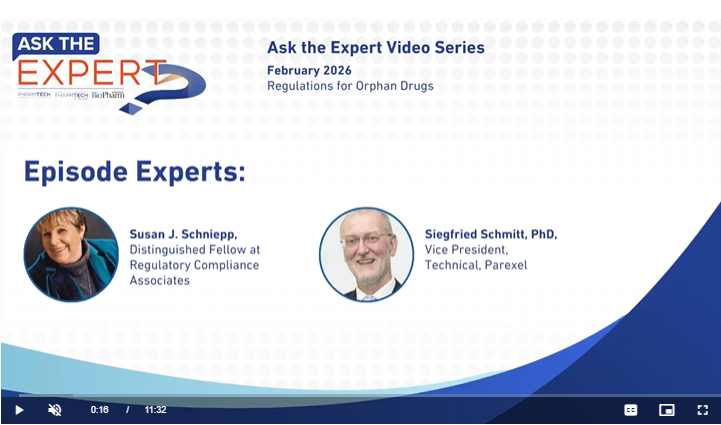
In this episode of the Ask the Expert video series hosted by Pharmaceutical Technology®, Susan J. Schniepp, Nelson Labs, and Siegfried Schmitt, Parexel, discuss the benefits of orphan drug development and how a mid-sized company can work with regulators through the pathway to approval.


Link to the Video and Article on Pharmaceutical Technology


In this episode of the Ask the Expert video series, Susan J. Schniepp, Distinguished Fellow, Regulatory Compliance Associates, a Nelson Labs Company, and Siegfried Schmitt, Vice President, Parexel, answer the question:


“We are a medium sized company and are looking to develop a new drug and are thinking of applying for orphan drug status. Do you have any suggestions for working regulators?”


For medium-sized pharmaceutical companies considering developing a drug for orphan drug designation, the transition from traditional development to rare disease therapy requires a shift in regulatory, clinical, and operational planning. An orphan drug is defined by the size of the population it treats; in the United States, this generally refers to conditions affecting 200,000 or fewer people,1 while the European Union uses a threshold of approximately five in 10,000.2


What are the regulatory and financial incentives

According to Schniepp and Schmitt, the orphan drug designation route offers government-backed incentives designed to offset the limited blockbuster potential of these products. These include financial support that includes government funding, grants, and tax credits. In the US, fees under the Prescription Drug User Fee Act may be waived for orphan drug developers. Regulators also offer more support for applications and faster approval timelines.


What challenges does the Orphan Drug pathway bring?

Orphan drugs must meet the same rigorous quality and compliance standards as traditional drug approvals , Schmitt and Schniepp emphasize. An accelerated approval process often means manufacturers must be more agile to apply high-level quality systems within a shorter timeframe.


Orphan drugs may also introduce specific manufacturing complexities. Producing smaller batches for clinical trials or commercial use is often more difficult than large-scale production.


Smaller companies without internal facilities may need to utilize contract development and manufacturing organizations (CDMOs). However, CDMOs may find it harder to integrate low-volume runs into their schedules compared to large-scale large tank production.


Because the patient population is small and globally dispersed, distributing small batches of product to far-reaching locations may also be a logistical hurdle.


Patient enrollment for rare-disease treatment development may be difficult, especially if multiple companies are competing for the same eligible participants. Medium-sized firms lacking regulatory experience should seek external expertise, according to Schmitt, and work in close collaboration with regulatory authorities. While these therapies may be commercial risks, they may lead to the discovery of broader indications for other diseases, Schniepp suggests, making them even more worthwhile to pursue.


References

  1. FDA. Office of Orphan Products Development. FDA.gov. Oct. 1, 2024 https://www.fda.gov/about-fda/office-chief-medical-officer/office-orphan-products-development (accessed Feb. 17, 2026).
  2. EMA. Orphan Designation. Overview. Ema.europa.eu. https://www.ema.europa.eu/en/human-regulatory-overview/orphan-designation-overview (accessed Feb. 17, 2026).

Background

A pharmaceutical manufacturer faced a significant capacity shortfall for a high-value drug product, with demand forecasts projecting accelerated growth. The expansion carried a high-risk profile due to complex interdependencies across construction, utilities, automation, commissioning and qualification (CQV), quality approvals, and regulatory submissions.

Compounding the challenge was an aggressive 24-month delivery timeline, alongside global supply chain volatility impacting critical equipment such as lyophilizers and isolators. Any delay across these integrated workstreams could jeopardize commercial supply continuity and regulatory readiness.

To mitigate risk and ensure timely delivery, the organization engaged Regulatory Compliance Associates® (RCA).

RCA Approach

RCA appointed a dedicated Program Manager (PM) to lead the initiative and assume ownership of the Integrated Master Plan (IMP) and Integrated Master Schedule (IMS). The PM coordinated all functional areas to ensure alignment across the project lifecycle, including:

  • Construction and facility build-out
  • Commissioning & Qualification (CQV)
  • Quality and QA oversight
  • Regulatory strategy and submission readiness
  • Compliance activities (CSV/GxP)
  • Environmental Health & Safety (EHS)
  • Operations readiness

A phase-gated governance model was established to control risk, enforce accountability, and align technical milestones with regulatory deliverables. RCA integrated CQV activities directly with validation planning and regulatory timelines to prevent downstream delays.

Inspection readiness was embedded early in the project, with proactive quality oversight and compliance alignment to ensure a seamless transition from build completion to regulatory approval.

Results

  • The facility was delivered, commissioned, and validated in Month 23, ahead of the 24-month target.
  • All critical utilities passed qualification on the first attempt.
  • The FDA inspection resulted in zero Form 483 observations.
  • The facility was cleared for commercial manufacturing within eight weeks of inspection.

Through disciplined program management, integrated governance, and proactive regulatory alignment, RCA helped the client successfully expand capacity while minimizing operational and compliance risk.

The FDA’s Quality Management System Regulation (QMSR) replaces the legacy QSR and formally incorporates ISO 13485:2016 (and ISO 9000:2015 Clause 3 for terminology) by reference. The final rule was issued on February 2, 2024, with an effective date of February 2, 2026 and it arrives with a new, lifecycle‑focused inspection model that retires QSIT.


Why did FDA replace QSR with QMSR?

For nearly three decades, manufacturers managed a U.S. QSR that diverged from global practice, creating duplicate compliance burdens. QMSR harmonizes with ISO 13485, modernizes expectations, and preserves specific U.S. obligations where needed, improving clarity while reducing redundancy for firms marketing in multiple jurisdictions.


The headline changes you’ll notice


ISO 13485 becomes the backbone of U.S. device CGMPs

QMSR restructures Part 820 to function as an overlay on ISO 13485:2016 (and ISO 9000:2015 for definitions), while retaining targeted FDA additions to avoid conflicts with U.S. requirements (e.g., records and labeling/packaging clarifications).


New inspection model; QSIT is retired

On the effective date, FDA begins inspections under Compliance Program 7382.850 and discontinues QSIT. Expect risk‑based planning, integration of post-market and lifecycle data, and inspectors following issues across processes rather than auditing subsystems in isolation.


Analyses show FDA will organize inspections around six QMS Areas and cover four “Other Applicable FDA Requirements” (MDR, Corrections/Removals, Tracking, UDI), often starting with your risk management file as the roadmap.


Terminology alignment: DHF/DMR/DHR → ISO terms

QMSR sunsets QSR‑only terms in favor of ISO vocabulary:

  • Design History File (DHF) → Design & Development File (DDF)
  • Device Master Record (DMR) → Medical Device File (MDF)
  • Design History Record (DHR) → Manufacturing Records/Records

FDA notes the content obligations remain under ISO clauses (especially 4.2 and 7.x) and retaining the old terms would be redundant and confusing.


Practical tip: You don’t have to rename every document, just ensure your files demonstrably meet ISO 13485 content and traceability, and keep a clear mapping for inspection.


Internal audits & management reviews are now fair game

Under QMSR and its new compliance program, industry observers and FDA‑facing legal analysts note that internal audits, supplier audits, and management review records are no longer categorically exempt. Treat them as inspection‑ready evidence.


MDSAP updates and new home

The MDSAP Audit Approach has been updated to Version 10 and is now hosted on MDSAP. Global, managed by Australia’s TGA, important for firms relying on MDSAP for global oversight alignment.


What doesn’t change—and where FDA adds clarity

QMSR supplements rather than displaces certain U.S. obligations. You should continue to reference UDI (21 CFR Part 830) and Medical Device Tracking (21 CFR Part 821) where ISO 13485’s text isn’t sufficiently specific for U.S. needs. FDA’s Part 820 overlay also emphasizes records and labeling/packaging controls to ensure U.S. expectations remain explicit.


Design controls under QMSR: clarifying Class I and risk

Class I exemptions: If your device was previously exempt from design controls, that status remains; QMSR doesn’t retroactively impose design controls on exempt devices. (Narrow exceptions for specific Class I products continue as before.)


Risk integration: Inspectors now begin with your risk management documentation and trace how risks drive design decisions, supplier oversight, production controls, and post-market actions reflecting the ISO 13485/ISO 14971 emphasis and the new compliance program’s lifecycle scope.


Inspections under CP 7382.850: what FDA evaluates now

FDA will test whether your QMS works as an integrated, risk‑driven whole:

  • Risk‑based sampling guided by your risk files; investigators follow issues across functions.
  • Lifecycle data integration (complaints, MDRs, recalls, servicing, supplier issues) feeding back into design/manufacturing changes.
  • Six QMS Areas + four OAFRs (MDR, Corrections/Removals, Tracking, UDI) form the backbone of inspection scope.


Do I have to buy ISO 13485 now?

Because QMSR incorporates ISO 13485 by reference, firms need to control the standard as an external document inside their QMS, typically requiring purchase and version control (per ISO 13485 clause 4.2.4 on external documents).


If you’re already ISO 13485‑certified: the lift is manageable

Most of the effort is validating coverage of the Part 820 overlay and tightening traceability to U.S. obligations (MDR, UDI, tracking, labeling controls). Expect incremental updates for servicing/installation records and labeling release/reconciliation to match FDA clarity.


FAQs

Q: Does QMSR change Class I design control exemptions?
A: No. Devices previously exempt remain exempt (with the same narrow exceptions).


Q: Does ISO 13485 certification replace FDA inspections?
A: No. FDA still inspects under QMSR and CP 7382.850; certification helps, but it’s not a substitute.


Q: Do we have to rename DHF/DMR/DHR?
A: Not necessarily. Ensure your content satisfies ISO 13485, maintain a clear mapping, and be consistent in training and retrieval.


How Regulatory Compliance Associates Can Support Your QMSR Transition

The shift from QSR to QMSR is more than a terminology update, it’s a transformation in how quality systems are evaluated. With ISO 13485 as the legal backbone of Part 820 and a risk‑based, lifecycle inspection model replacing QSIT, the standard is clear: demonstrate real‑world system effectiveness.


Why partner with RCA now?

  • QMSR Gap Assessment & Implementation Support—map current QSR systems to ISO 13485 + FDA overlay (records, labeling/packaging).
  • SOP & Document Modernization—align MDF/D&D files and manufacturing records with inspection‑ready ISO/FDA expectations.
  • Risk Management Integration—embed ISO 14971 across design, suppliers, production, and post-market—the first stop for investigators.
  • Mock FDA Inspections (CP 7382.850)—train on the new lifecycle framework (risk‑based sampling; six QMS Areas + OAFRs).
  • MDSAP Alignment—update readiness to MDSAP Audit Approach v10 (MDSAP.Global).


Ready to strengthen your quality system and prepare for QMSR?


Contact Regulatory Compliance Associates today to schedule a QMSR readiness review or request a customized support plan. Your next inspection will test how your system performs, not just what’s on paper.

Susan J. Schniepp, distinguished fellow at Regulatory Compliance Associates, a Nelson Labs Company, outlines the importance of batch recovery procedures in pharmaceutical manufacturing.


Q: What is the best way to perform batch recovery procedures for the manufacturing of pharmaceutical products?


A: Pharmaceutical batch recovery is a critical process in the manufacture of medicines. The batch recovery process is performed when there is a deviation during manufacturing, and the situation is such that there may be a potential to “recover” the batch while still ensuring the final product meets quality, safety, and compliance standards. Batch recovery involves identifying and rectifying any deviations or issues that occurred during the production of the specific batch in question by conducting a thorough investigation resulting in definitively identifying the root cause of the deviation. The investigation should involve collaboration between quality assurance, production teams, and regulatory authorities. The batch recovery process should define the details of the root cause analysis as well as any future corrective and preventive actions to prevent recurrence. This will help determine if the batch is suitable for recovery.


The main challenge in batch recovery is quickly identifying the root cause of the deviation. Investigations can sometimes be complex and may take more time to come to root cause. This impacts the ability to be able to recover the batch especially when dealing with time sensitive products that may degrade while awaiting the outcome of the investigation. Regardless of the product involved and the criticality of the situation, care must be taken to maintain consistent, thorough documentation, and timely communication with management and regulatory authorities to guarantee the recovered product meets all quality, safety, and regulatory standards, thereby ensuring patient safety.


One of the most important elements in considering batch recovery steps is making sure that a robust quality control system has been implemented across the company. The culture of the organization must be mature enough before undertaking batch recovery operations. This includes, but is not limited to, having appropriate risk analysis procedures, robust documentation and change control procedures, a highly trained staff, a comprehensive investigation process, and adherence to data integrity requirements. Continuous improvement and regular facility audits will help prevent the issue from recurring in the future.


The decision to perform a batch recovery is a difficult one. It is important to understand when a batch recovery procedure can be utilized and when it would be inappropriate to try to and recover a batch. The determination to perform a batch recovery will depend on the severity of the deviation and if the root cause that prompted the deviation was successfully identified with documented supporting evidence. Batches that have more than one deviation during that manufacturing process should not be considered suitable for batch recovery.


The ideal situation is to try and avoid batch recovery situations by having a robust quality system that values continuous process improvement based on identifying root causes for deviations and proactively implementing changes. It is essential to follow best practices and proactively address manufacturing challenges upfront. Identifying the true root cause of the deviation not only helps minimize cost, especially when expensive active ingredients are involved, but helps maintain product integrity that meets regulatory commitments. Even if you have all the necessary elements imbedded into the quality system, unexpected occurrences may lead to a scenario where the company needs to determine whether a batch can be recovered. By following best practices and employing continuous process improvements based on robust investigations and corrective and preventative actions, manufacturers can potentially recover a batch that might otherwise be rejected.


Article details

Pharmaceutical Technology®
Vol. 49, No. 9
Page: 26


Citation

When referring to this article, please cite it as Schniepp, S.J. Fundamentals of Batch Recovery Procedures. Pharmaceutical Technology 2025 49 (9).


Partner With Experts Who Strengthen Your Quality & Compliance Framework

Batch recovery decisions demand deep technical expertise, disciplined investigation practices, and a mature quality culture. Regulatory Compliance Associates® helps pharmaceutical manufacturers navigate complex deviations, strengthen root cause analysis, and build the robust quality systems needed to prevent issues before they occur.


If your team needs support with investigations, remediation, or elevating your overall quality and compliance maturity, RCA is here to help.

Learn more or connect with our experts today: https://www.rcainc.com/contact-us/