



















Published Articles
In this episode of the Ask the Expert video series hosted by Pharmaceutical Technology®, Susan J. Schniepp, Nelson Labs, and Siegfried Schmitt, Parexel, discuss the benefits of orphan drug development and how a mid-sized company can work with regulators through the pathway to approval.
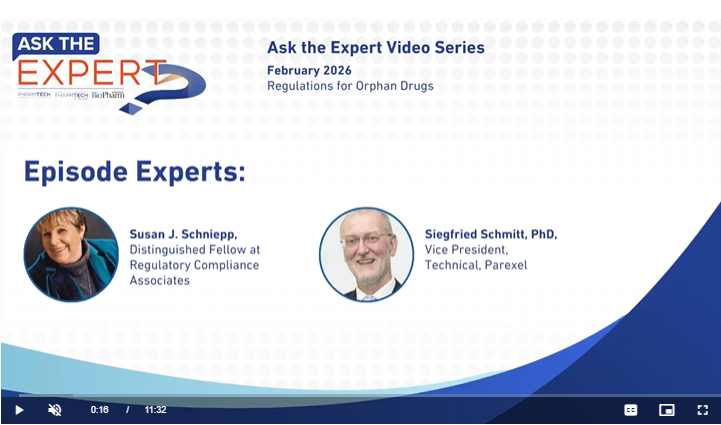
Link to the Video and Article on Pharmaceutical Technology
In this episode of the Ask the Expert video series, Susan J. Schniepp, Distinguished Fellow, Regulatory Compliance Associates, a Nelson Labs Company, and Siegfried Schmitt, Vice President, Parexel, answer the question:
“We are a medium sized company and are looking to develop a new drug and are thinking of applying for orphan drug status. Do you have any suggestions for working regulators?”
For medium-sized pharmaceutical companies considering developing a drug for orphan drug designation, the transition from traditional development to rare disease therapy requires a shift in regulatory, clinical, and operational planning. An orphan drug is defined by the size of the population it treats; in the United States, this generally refers to conditions affecting 200,000 or fewer people,1 while the European Union uses a threshold of approximately five in 10,000.2
What are the regulatory and financial incentives
According to Schniepp and Schmitt, the orphan drug designation route offers government-backed incentives designed to offset the limited blockbuster potential of these products. These include financial support that includes government funding, grants, and tax credits. In the US, fees under the Prescription Drug User Fee Act may be waived for orphan drug developers. Regulators also offer more support for applications and faster approval timelines.
What challenges does the Orphan Drug pathway bring?
Orphan drugs must meet the same rigorous quality and compliance standards as traditional drug approvals , Schmitt and Schniepp emphasize. An accelerated approval process often means manufacturers must be more agile to apply high-level quality systems within a shorter timeframe.
Orphan drugs may also introduce specific manufacturing complexities. Producing smaller batches for clinical trials or commercial use is often more difficult than large-scale production.
Smaller companies without internal facilities may need to utilize contract development and manufacturing organizations (CDMOs). However, CDMOs may find it harder to integrate low-volume runs into their schedules compared to large-scale large tank production.
Because the patient population is small and globally dispersed, distributing small batches of product to far-reaching locations may also be a logistical hurdle.
Patient enrollment for rare-disease treatment development may be difficult, especially if multiple companies are competing for the same eligible participants. Medium-sized firms lacking regulatory experience should seek external expertise, according to Schmitt, and work in close collaboration with regulatory authorities. While these therapies may be commercial risks, they may lead to the discovery of broader indications for other diseases, Schniepp suggests, making them even more worthwhile to pursue.
References
- FDA. Office of Orphan Products Development. FDA.gov. Oct. 1, 2024 https://www.fda.gov/about-fda/office-chief-medical-officer/office-orphan-products-development (accessed Feb. 17, 2026).
- EMA. Orphan Designation. Overview. Ema.europa.eu. https://www.ema.europa.eu/en/human-regulatory-overview/orphan-designation-overview (accessed Feb. 17, 2026).
Connect with RCA Today
Contact us to learn more about our regulatory compliance experts and how they can help
