


















Archives: Published Articles

Insights on driving value from staffing, automation and continuous improvement.


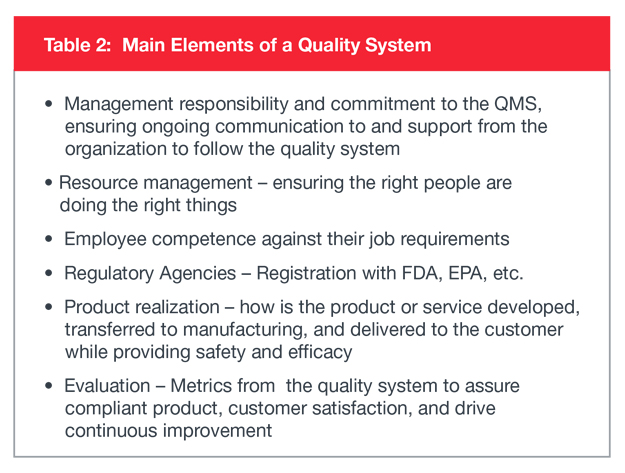
Developing a quality management system is the foundation for ensuring the organization’s products or services are safe, effective and controlled to deliver customer satisfaction. Throughout the organization’s lifecycle, from start-up through maturity, the quality needs of the firm, along with its budget constraints, are continually evolving. Maintaining compliance with regulations while controlling costs represents a challenging balancing act we encounter in our life science consultancy. The most successful firms apply critical assessment of their needs and gaps at present and in the future, and deploy a risk-based approach to their quality system.


Upfront Planning Avoids Costly Surprises


Before establishing a quality system, it’s critical to identify the quality standards, regulations and/or requirements surrounding the company’s products, service and business needs. The checklist in Table 1 provides some common areas to consider.


Gap Analysis


If your organization already has a quality system, perform a gap analysis against your identified standards/requirements per Table 1. If your quality team could benefit from an external assessment, consider hiring an experienced consultant or firm to provide expertise in the gap analysis.


ISO13485


If your organization is or will be manufacturing or distributing internationally, global considerations will add complexity to your quality system. For example, the following considerations can greatly impact the complexity of the quality system; European Union, ISO13485, Canadian Medical Devices Regulations, Brazilian GMP, and Japanese Ordinance #169, and others.


Phased Enhancements: Spread the Spend Over Time


quality management system


Maximizing Value from Staffing


  • Quality System Leader The organization requires a competent and knowledgeable individual as the quality system leader(s) who may implement the QMS, keep the system compliant, and maintain the design history file.
  • Based on the lifecycle of the organization, the quality system leader may be tasked with implementing the QMS or just maintaining the QMS going forward. This could be two different skill sets.
    • Tip: Early stage companies can benefit from outsourcing development of the QMS to highly experienced quality consultants and then transition maintenance of the QMS to less expensive in-house personnel.
  • Skill Assessment By analyzing the skill sets of in-house quality personnel against needs, firms can identify gaps and develop solutions. A few considerations:
    • Tip: Can current staff be trained? Training represents an upfront cost but offers long- term payoff.


Training Programs


  • Utilize assessments and audits to understand the capabilities ceiling of your existing team. If training cannot close the critical gaps, consider whether the needed skill set is temporary or long-term. Temporary gaps can be closed cost effectively through hiring of contractors or DHF consultants to provide specialized knowledge without paying for a full-time employee. Such expertise can be used for:


Maximizing Value from Automation


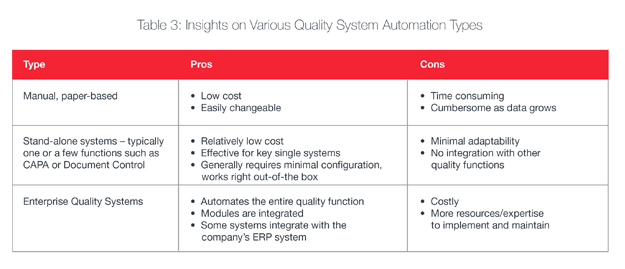
  • Start-up or early stage organizations can benefit from basic manual systems or hybrid systems that automate some of the more labor-intensive quality functions such as document control.
  • Mid-market organizations can benefit from increased automation through hybrid or enterprise QMS systems that address multiple quality needs such as document control, deviations control, non-conformance, equipment calibration, equipment maintenance orders, audit, CAPA, change control, training and functions that control product outputs.
  • Large organizations can benefit from enterprise QMS systems and integrating those systems with their ERP systems for even greater interoperability.


Maximizing Value from Continuous Improvement


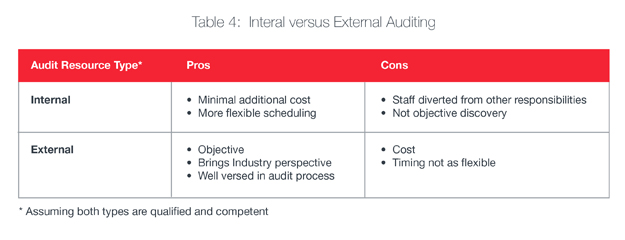
  • Internal and external audits program
  • Complaints
  • Customer feedback
  • CAPA system
  • Product or process non-conformances
  • Processing data
  • Enforcement activity such as a FDA 483 or Warning Letter
  • Costs relative to the budget
  • Concerns about cybersecurity and cost


Budget Maximizing Tips


Travel:

  • Limiting travel by employees and choosing local contractors or consultants to minimize this expense.
  • For organizations with multiple locations, consider leveraging the geography of the company’s quality personnel. For example, if facility A has an out-of-state supplier located near sister facility B, then facility A might be able to tap into the facility B personnel to perform the supplier audit. The travel savings could offset the cost to quality facility B personnel on the QMS audit.

Training:

  • Delaying training can minimize this expense. Although it can be less expensive in the long run to raise the skill set of your employees in areas such as internal audits, some companies trim budgets by foregoing to deferring training.
  • Virtual cGMP training is another possibility to minimize training expense. By training all your employees at once, companies can negotiate reduced training fees and may possibly eliminate department travel by having a trainer come onsite to the company.
  • Delaying supplier audits Sometimes audits can be scheduled to the next quarter or early next year to save expense based on the acceptable risk exposure.
  • Group input: The quality team is the cornerstone of the QMS. Engaging these internal experts can identify creative opportunities to trim expenses while minimizing risk.


Today’s Quality leaders are responsible for managing the organization’s compliance and cost of quality, while driving customer satisfaction and maximizing their department budgets. Careful planning and judicious use of human capital and other resources are critical in deploying a risk-based strategy that delivers organizational results.


About RCA’s Medical Device Consulting Services


The regulatory compliance process surrounding the medical device industry involves a strict adherence to pre/post market information throughout a device’s life cycle. Even a single compliance issue you have can turn into a significant effect on your business. Regulatory Compliance Associates can help guide you through any stage of the medical device consulting process, with capabilities during product development through the regulatory clearance/approval of your product.


Our team of over 500 medical device consulting Experts — including former FDA officials and regulatory compliance leaders in the field of medical device regulation — will work with your company to create a quality assurance and regulatory compliance approach tailored to your products and regulatory needs. Regulatory Compliance Associates works with international Fortune 100 companies, venture capital start ups, and companies of all sizes and shapes. Our regulatory compliance solutions for law firms include remediation for warning letters, FDA 483’s, import bans or consent decrees. Very few regulatory compliance services have the same regulatory compliance expertise in a variety of medical fields.


Medical Device Cybersecurity


For medical device manufacturers, technology can be a double-edged sword. The innovative technologies that elevate the quality of life for patients can also be used to potentially undermine the organization using the device. The consequences can affect the device itself if Regulatory Compliance Associates medtech consultants do not implement good IoT cybersecurity and FDA cybersecurity protocols.


At Regulatory Compliance Associates, we offer a wide variety of services for medical devices security to help ensure that your product is protected from cyber-attacks. With a well-planned design, along with full visibility of product development and the supply chain, Regulatory Compliance Associates medical device consultant Experts can help strengthen your device’s cybersecurity. We partner with medical device companies in each phase of the design cycle. The RCA medical device consulting team understands protecting inputs from threat exposure and hardening outputs for regulatory compliance & FDA submission approval.


  • SaMD Consulting
  • Threat Modeling
  • Proof of Concept
  • Quality Assurance Services
  • TIR 57 & TIR 97
  • ISO 62304
  • ISO 27001


Regulatory Affairs


Regulatory affairs is Regulatory Compliance Associates® backbone. We handle more regulatory consulting submissions in a month than many manufacturers do in a lifetime. Our regulatory compliance consulting Experts have experience working with the FDA, global regulatory bodies and / or agencies, and notified bodies worldwide. Therefore, you can count on us for in-depth and up-to-date insights which increase speed-to-market.


As a trusted regulatory affairs consultant, our FDA veterans and regulatory consulting team represents Regulatory Compliance Associates® as one of the top medical device consulting firms. We’lll help you navigate the medical device consulting difficulties associated with new product submissions. Regulatory Compliance Associates® medical device consulting company has expertise in both the approval process and post-approval support. 


  • New Product Approval
  • Post-Approval Support
  • Outsourced Staffing
  • EU MDR
  • Combination Products


Compliance Assurance


Increasingly, life science companies are feeling the pressure of greater scrutiny by regulators, and responding by developing sustainable compliance strategies. Whether it’s preparing for an audit, developing a response to an FDA finding, or remediation to an adverse event, Regulatory Compliance Associates® can help.


Our network of over 500 medical device consultant & FDA, MHRA & EMA veterans are industry professionals offers a unique blend of expertise. This allows Regulatory Compliance Associates® to handle both simple and complex regulatory compliance challenges within medical device consulting companies.


  • Gap Assessments
  • Internal Audits
  • Employee Training
  • Notified Body Response
  • Data Integrity


Quality Assurance


Regulatory Compliance Associates® is globally reknown for quality assurance services, including quality system assessments, strategy, implementations, and quality metrics to ensure continuous improvement. Each Regulatory Compliance Associates® medical device consultant is a quality expert with experience spanning major corporations and start-ups. RCA’s quality assurance services experts know firsthand how to achieve, maintain, and improve quality, and we excel in transferring this knowledge to your organization.


In the medical devices field, quality assurance (QA) is more than merely ensuring the quality of a finished product. You need the tools to monitor and regulate every process from the design of a new product to continued quality compliance as the device is sent to market. At Regulatory Compliance Associates®, we offer you the quality assurance services you need to monitor these processes and ensure quality compliance every step of the way.


With more than 20 years experience working with medical device consulting companies, Regulatory Compliance Associates® trusted medical device quality assurance consultant team is fully equipped to handle your unique QA needs.


  • ISO13485 
  • 21 CFR 210
  • 21 CFR 211
  • Outsourced Staffing
  • MDSAP
  • Facility Validation
  • Equipment Validation
  • Quality Metrics


Remediation Services


Regulatory Compliance Associates® is widely recognized within medical device consulting companies & the life science industry for our remediation services & support. Regulatory Compliance Associates® ability to help companies successfully resolve complex regulatory challenges have a proven track record of success. Our medical device consulting services include significant experience with the development of responses to 483 Observations, Warning Letters, Untitled Letters and Consent Decrees.


  • Regulatory Action
  • Regulatory Compliance
  • Regulatory Enforcement
  • Warning Letter
  • 483 Observation
  • Oversight Services


Our value goes beyond the initial response by helping companies successfully execute their action plans, develop an improved compliance culture tailored to the needs of their business, and ultimately move beyond the regulatory action to emerge as a stronger business. We negotiate difficult demands of remediation with insight and the clear advantage of our medical device consultant expertise and experience that makes partnering with Regulatory Compliance Associates®  a competitive differentiator in the remediation space.


  • Quality System
  • Technical File
  • Design History File
  • Data Integrity
  • cGMP


Strategic Consulting


Whether it’s a strategy, a technical plan, or project, Regulatory Compliance Associates® medical device consultancy can help ensure a successful project. Regulatory Compliance Associates® due diligence consulting can deliver your project on time, on budget, and you’re never embroiled in a costly mistake. 


Our medical device consultant Experts are industry Experts are here to provide the unique insight you need before an M&A deal, through a staffing crisis and in every area of your product’s development and life cycle. As the trusted medical device manufacturing consultants of thousands of companies around the world, we have the knowledge and expertise needed to deliver exceptional results to your business — no matter your size or unique needs.


  • Manufacturing Optimization
  • Product Lifecycle Management
  • Mergers & Acquisitions (M&A)
  • Due Diligence
  • Device Vigilance
  • Risk Management Plan
  • Product Complaints
  • Medical Information


About Regulatory Compliance Associates


product developmentRegulatory Compliance Associates® (RCA) provides medical device consulting to the following industries for resolution of life science challenges:


We understand the complexities of running a life science business and possess areas of expertise that include every facet of R&D, operations, regulatory affairs, quality, and manufacturing. We are used to working on the front lines and thriving in the scrutiny of FDA, Health Canada, MHRA and globally-regulated companies.


As your partners, Regulatory Compliance Associates can negotiate the potential minefield of regulatory compliance and regulatory due diligence with insight, hindsight, and the clear advantage of our unique expertise and experience.


  • Founded in 2000
  • Headquartered in Wisconsin (USA)
  • Expertise backed by over 500 industry subject matter experts
  • Acquired by Sotera Health in 2021


About Sotera Health


The name Sotera Health was inspired by Soteria, the Greek goddess of safety, and reflects the Company’s unwavering commitment to its mission, Safeguarding Global Health®.


Sotera Health Company, along with its three best-in-class businesses – Sterigenics®Nordion® and Nelson Labs®, is a leading global provider of mission-critical end-to-end sterilization solutions and lab testing and advisory services for the healthcare industry. With a combined tenure across our businesses of nearly 200 years and our industry-recognized scientific and technological expertise, we help to ensure the safety of over 190 million patients and healthcare practitioners around the world every year.


We are a trusted partner to more than 5,800 customers in over 50 countries, including 40 of the top 50 medical device companies and 8 of the top 10 pharmaceutical companies.


Commitment to Quality


Our Certificate of Registration demonstrates that our Quality Management System meets the requirements of ISO 9001:2015, an internationally recognized standard of quality.


To begin the Regulatory Compliance Associates® scoping process today, please enter your information in the blue form below and click the submit button at the bottom of the webpage. 


Q: I saw where FDA released draft guidance on data integrity. In the guidance, the answer to question 16 says personnel should receive cGMP training to detect data integrity issues as part of a routine current good manufacturing practice (CGMP) training program. Can you give me some advice on how this topic would be addressed in the annual cGMP training?


cGMP trainingA: This is a great question. The draft guidance, titled Data Integrity and Compliance With cGMP was released in 2016 and is still current. In the introduction, FDA states, “The purpose of the guidance is to clarify the role of data integrity in current good manufacturing practice …” I don’t think the industry should be surprised by this guidance based on the number of recent warning letters issued with citations referencing questionable data integrity practices.


The guidance itself says:


“… FDA has increasingly observed CGMP violations involving data integrity during CGMP inspections.”


The guidance goes on to say:


“This is troubling because ensuring data integrity is an important component of industry’s responsibility to ensure the … quality of drugs, and FDA’s ability to protect the public health.”  


Specifically question 16 asks:


“Should personnel be trained in detecting data integrity as part of a routine CGMP training program?”


The answer in the guideline is, of course, yes and cites 21 Code of Federal Regulations (CFR) 211.25 and 212.10, which require that employees have the “education, training, and experience, or any combination thereof, to perform their assigned duties.”


From an industry perspective, the requirement for data integrity training seems new, but it isn’t. It is normally referred to as good documentation practices (GDP), annual GMP training, and investigations and corrective action and preventive action (CAPA) training. The question is how does one communicate to others that this training regimen relates to proper data handling, which in turn helps eliminate data integrity issues.  


cGMP Training


Annual cGMP training is integral to avoiding data integrity problems because it delineates what documents need to be maintained. If the GMPs require a document be preserved, one can assume it is a document that is subject to review and critique during an audit.


Focusing on the forms and records required allows one to direct their review efforts on the essential rather than on the superfluous documents that support the safety, efficacy, and quality of the products being manufactured. Once the company’s quality assurance (QA) department has identified these critical documents, the documentation group can then direct their efforts towards appropriately maintaining those documents.  


GDP training


A critical element in preserving the integrity of the information contained in these records is related to GDP training. GDP training should explain to the employees the necessity of the document in relationship to the quality of the product.


GDP training should focus on the importance of the data being recorded, how to correct an error, how to document the reason for the error, explain the timeliness of the signature and date of the person who performed the operation and recorded the necessary information, as well as the role of the verifier’s signature for those steps in the operation that require a witness.


Electronic Signature


GDP training should also include an explanation of the review process and what the operator’s, verifier’s, and reviewer’s signatures means. The reviewer’s signature should be regarded as complementary to the original operator’s signature. It is there to support that the recording of the data was complete, accurately reflected the function or activity being documented, and that any operational errors that occurred were investigated and corrected appropriately.


If you are operating with electronic signatures and data collection systems, training should include discussion on the importance of password protection and the reason and rationale for not sharing passwords and accounts so that the integrity of the electronic system is not compromised.


CAPA training  


Investigation and CAPA training should be taught to staff involved in the recording and reviewing of the documentation. It is important for these individuals to understand how deviations are investigated, if the investigation resulted in a CAPA, and what impact the investigation/CAPA results might have on the product.


It should also address how changes made to documentation as a result of the investigations/CAPA have been implemented in the quality management system. Documentation changes made as a result of investigation/CAPA conclusions should prompt retraining on the activity and should encompass any new documentation practices identified.  


Internal Audit


Once the employees are trained in GMP, GDP, and investigations/CAPA training, the QA group should confirm the organization’s understanding of what they were taught through the internal audit review process. This should be viewed as a confirming activity that will strengthen the records, forms, reports, and manufacturing documents that support the product’s manufacturing and release.


Standard Operating Procedures (SOP)


Issues in documentation procedures identified through the internal audit process should be responded to and tracked in a similar manner, as the company would do for an external audit by a client or a regulatory agency.  


The information collected during the manufacturing of the product from the receipt of the raw materials, the facility maintenance, the testing of the product up to the release of the product, and everything in between is crucial to defending the product once it has been released for patient use. It is crucial that this information be indisputable, whether it is electronic or paper.


Documentation


Bottom line, don’t over react to the guidance by sending your QA staff to criminal investigation training. Instead, utilize the cGMP training tools you already have in your quality system to reinforce the concept of data integrity throughout your training and audit processes. The best way to combat poor documentation is through the proactive inclusion of data integrity concepts, design, and implementation into your data collection systems whether they are manual or electronic in nature.  


Article Details


Pharmaceutical Technology

Vol. 40, No. 6
Pages: 57–58  


About RCA’s Pharmaceutical Consulting Services 


Regulatory Compliance Associates (RCA) has helped thousands of pharmaceutical companies meet regulatory, compliance, quality assurance, and remediation challenges. With more than 20 years of experience with FDA, Health Canada, EU and global regulatory agencies worldwide, Regulatory Compliance Associates® offers leading pharmaceutical consultants. We’re one of the few pharma consulting companies that can help you navigate the challenges associated with industry regulations.


Our pharmaceutical consulting firm includes over 500 seasoned FDA, Health Canada & EU compliance consultants and regulatory affairs experts who understand industry complexities. It’s a pharma consultancy founded by regulatory compliance executives from the pharmaceutical industry. Every pharmaceutical industry consultant on the Regulatory Compliance Associates team knows the unique inner workings of the regulatory process. 


Client Solutions


Whether you’re in the product planning, development or pharmaceutical lifecycle management stage or need a remediation strategy for a compliance crisis, Regulatory Compliance Associates will guide you through every pharmaceutical consulting step of the regulatory process and create a customized approach depending on your product and your pharma company’s individual needs. Our regulatory compliance clients include:


  • Companies new to FDA, Health Canada or EU regulations and regulatory compliance
  • Start-up organizations with novel submissions to 510(k) submissions from multi-national corporations
  • Investment firms seeking private equity due diligence for pre-acquisition and post-deal research
  • Law firms seeking pharmaceutical consulting firm expertise in the remediation of warning letters, consent decrees, 483’s or import bans


Regulatory Affairs


Regulatory affairs is Regulatory Compliance Associates backbone. We exceed other pharma consulting companies with industry experts experienced in complexities of the pharmaceutical and biopharmaceutical industries. Our pharma consulting expertise spans all facets and levels of Regulatory Affairs, from Regulatory Support for New Products to Life Cycle Management, to other services like Outsourced Regulatory Affairs, Submissions, Training, and more.


As your partner, we can negotiate the potential assessment minefield of regulatory compliance services with insight, hindsight, and the clear advantage of our breadth and depth of knowledge and regulatory compliance consulting. We offer the following pharma consulting regulatory affairs services for pharmaceutical companies.


  • New Product Support
  • Product Lifecycle
  • Other Regulatory Services
  • Combination Products


Compliance Assurance


The regulations process surrounding pharmaceutical companies can be tricky for even the most experienced industry veteran to understand. Just one misstep could mean significant and lasting consequences for your business. At Regulatory Compliance Associates, we offer the pharma consulting experience and pharma consultants necessary to guide you through the quality compliance process.


  • Assessments
  • Audits
  • Regulatory Agency Response
  • Preparation and Training
  • Inspection Readiness
  • Data Integrity


Quality Assurance


Regulatory Compliance Associates Quality consulting includes assessments, strategy, implementations, staff augmentations, and identification of quality metrics to ensure continuous improvement. Our pharma consultants understand the strategic thinking needed to align your business needs and goals. Regulatory Compliance Associates quality assurance services include quality experts with experience spanning major corporations and start-ups. Our pharmaceutical consulting firm knows firsthand how to achieve, maintain, and improve quality, and we excel in transferring pharma consulting knowledge to your organization.


  • 21 CFR Part 11
  • Data Integrity
  • Manufacturing Support
  • Facility Support
  • Quality Metrics


Remediation Services 


Regulatory Compliance Associates has a proven remediation services approach to managing FDA Warning Letters, Consent Decrees, Remediation and other serious regulatory situations. Our pharma consultants know how to partner with executive, legal, and communication teams. Each RCA pharma consulting Expert will develop a response that will be accepted by the regulatory agency and be realistic to execute.


Regulatory Compliance Associates pharma regulatory consultants will develop a comprehensive proof book of documented evidence demonstrating the corrective action taken to remediate non-compliant issues. In addition, each Regulatory Compliance Associates pharma consulting Expert understands compliance enforcement. We’ll prepare a comprehensive pharma consulting strategy to assist in your remediation efforts, drive continuous improvement, and maintain regulatory compliance with the regulations.


  • Regulatory Action
  • Regulatory Compliance
  • Regulatory Enforcement
  • Warning Letter
  • 483 Observation
  • Oversight Services
  • Risk Management Plan


About Regulatory Compliance Associates


pharmaceutical consultantsRegulatory Compliance Associates® (RCA) provides pharmaceutical consulting to the following industries for resolution of life science challenges:


We understand the complexities of running a life science business and possess areas of expertise that include every facet of R&D, operations, regulatory affairs, quality, and manufacturing. We are used to working on the front lines and thriving in the scrutiny of FDA, Health Canada, MHRA and globally-regulated companies.


As your partners, we can negotiate the potential minefield of regulatory compliance and regulatory due diligence with insight, hindsight, and the clear advantage of our unique expertise and experience.


  • Founded in 2000
  • Headquartered in Wisconsin (USA)
  • Expertise backed by over 500 industry subject matter experts
  • Acquired by Sotera Health in 2021


About Sotera Health


The name Sotera Health was inspired by Soteria, the Greek goddess of safety, and reflects the Company’s unwavering commitment to its mission, Safeguarding Global Health®.


Sotera Health Company, along with its three best-in-class businesses – Sterigenics®Nordion® and Nelson Labs®, is a leading global provider of mission-critical end-to-end sterilization solutions and lab testing and advisory services for the healthcare industry. With a combined tenure across our businesses of nearly 200 years and our industry-recognized scientific and technological expertise, we help to ensure the safety of over 190 million patients and healthcare practitioners around the world every year.


We are a trusted partner to 5,800+ customers in over 50 countries, including 40 of the top 50 medical device companies and 9 of the top 10 pharmaceutical companies.


Commitment to Quality


Our Certificate of Registration demonstrates that our Quality Management System meets the requirements of ISO 9001:2015, an internationally recognized standard of quality.


To begin the Regulatory Compliance Associates scoping process today, please enter your information in the blue form below and click the submit button at the bottom of the webpage. 


Lisa L. Michels, General Counsel and regulatory affairs expert at Regulatory Compliance Associates® Inc., discusses how the global medical device regulatory landscape is impacted by international law.


The global medical device regulatory landscape is constantly evolving as governing bodies and/or agencies worldwide continue their efforts to harmonize and streamline rules. Over the last several years, many of these regulatory bodies have joined forces to ensure consistency in the interpretation, application, and implementation of relevant medtech regulations and globally recognized consensus standards.


Regulatory Submission


While such efforts have considerably improved the product registration process overseas, harmonization in some cases has made it difficult for some device firms to stay abreast of the planet’s evolving regulatory landscape. To remain competitive in this challenging environment, medtech companies stay ahead of the competition by proactively planning for new and/or changing global regulations. This helps agile organizations successfully launch existing, modified, or novel products in new target markets quickly. 


Medical Device Registration


Most companies want their products to be registered in as many global markets as possible, but this lofty goal introduces certain regulatory challenges. From a general business perspective, global product registration in numerous foreign markets obviously makes sense.


Companies possessing the legal authority to sell product(s) in certain regions where competitors are not authorized to do so often distinguishes those organizations as leaders or industry trailblazers. This approach is not always logical or practical, however.


Regulatory Pathway


Product registration should be based on a proactive strategic regulatory analysis. Understanding the available regulatory pathway options can help properly determine whether registration in a particular market. Ultimately, the team is challenges with the regions that make sense for the product and business as a whole.


The most common international medical device registration challenges are primarily based on the following considerations:

  • Understanding and applying country-specific medical device regulations across global markets
  • Timely implementation of country-specific medical device regulations in target markets
  • Costs associated with global product registration(s), which may include (but are not limited to) in-country agent representation, in-country product testing, and in-country collection of clinical data
  • Excessive delays and/or long lead times for regulatory reviews needed for global product registration(s) in target markets


Device Classification


These challenges are much easier to manage when they are properly assessed well before starting the product registration processes in certain global markets. Based on the device classification and type of product, there may be more (or less stringent) requirements that must be achieved in specific countries.


The risk level of the product and the existence of similar approved products in a particular market can complicate the product registration process in certain countries.


Medtech Programs


Many medtech companies typically tend to focus their medical device product registration efforts on seven (7) primary global markets: the United States, Canada, European Union (EU), Australia, Brazil, China, and Japan. Due to ongoing harmonization efforts, these countries are working together to streamline the registration processes and improve their consistency. 


Depending on the company’s overall product launch strategy, device registration in emerging markets has become common in recent years. In certain cases, product registration may be less challenging in these markets because regulations have not yet been fully developed.


Pre-Clinical Testing


The applicable medical device regulations in target markets each pose their own product registration challenges. Therefore, it is imperative that companies plan for all target market requirements early in the product development process—ideally at the idea stage.

Understanding and preparing for the hurdles associated with pre-clinical testing, clinical testing, performance testing, safety testing, labeling, and compliance with harmonized standards, can help companies overcome possible challenges with the product registration process in each potential target market.


regulatory compliance
 
Table: Summary Regulatory Requirements for Global Medical Device Registration in the Primary Target Markets


Regulatory Compliance


Achieving product registration compliance in each target market may seem like a daunting endeavor, but it’s not truly as complicated as it sounds. There are many similarities between the various regulations, as outlined in the table at right. Although the table represents only a subset of requirements, the country-specific mandates applicable to product type in each of the target markets must be carefully reviewed and assessed.


The most effective method to accomplish this task is to prepare a global regulatory strategy for the product(s), which may ultimately be used as a gauge to determine the likelihood of successfully launching a device in a particular market.


Regulatory Strategy


A global regulatory strategy is a documented analysis that defines the overall business objectives and requirements necessary for foreign product registration. A regulatory plan, on the other hand, is a comprehensive report based on the foundational regulatory strategy that outlines all product- and country-specific registration mandates in particular markets. 


The regulatory strategy and plan may be separate stand-alone documents or combined into a single global strategy and planning file. Regardless of format, however, their purpose is the same—to proactively document and plan for the implementation of applicable regulatory requirements associated with specific products in each target market.


Regulatory Audit


Keep in mind that these regulatory strategy and planning document(s) are not static. They must be updated and revised accordingly when changes are made either to the product itself or to the device’s launch strategy. A revision would be required, for example, if target markets are added or removed from the launch strategy. Any regulatory body will want to understand the risks made to existing products and regulations (particularly when new rules are introduced that can significantly affect or completely alter product registration mandates).


The format of the regulatory strategy and planning document ultimately depends on the company. Some organizations encourage the use of a specific format or template to document the regulatory strategy and/or plan. Other firms are more liberal about format.


Medical Device Regulatory


Fundamentally though, the setup of the regulatory strategy and planning document is not as important as the goal: To initiate and maintain robust, proactive, regulatory planning efforts as early as possible, and to effectively monitor any changes in the scope to avoid unexpected and costly delays. The key elements of a global regulatory strategy and planning document are also outlined in the table. 


Medical Device Global Regulatory Strategy and Planning Document


Detailed Product Summary

  • Detailed description of the product including its accessories, components, and software (if applicable)
  • Describe the product requirements, including technological/functional/performance/clinical requirements of the product (e.g., what the product does and how it works/mode of operation)
  • Indications for use/intended use
  • Target population
  • Labeling requirements
  • All proposed marketing claims and requirements for claim substantiation
  • Risk level/product classification/applicable product codes
  • Predicate(s) and/or similar products on the market in each target country


Governing Regulatory Body and/or Agency in Each Target Market

  • Planned target markets for product launch
  • Applicable laws, regulations, standards, and relevant guidance for the product
  • Analysis of harmonized requirements and standards for the product across all target markets
  • Reimbursement requirements and other country-specific considerations


Proposed Regulatory Pathway and Product Registration Requirements in Each Target Market

  • Regulatory submission/product registration requirements, including all applicable product testing requirements (e.g., pre-clinical testing, animal testing, clinical testing, performance testing, safety testing, etc.)
  • Timeline to obtain clearance/approval
  • Costs associated with global product registration
  • Required resources (internal/external)
  • Pre-market submission/early interaction, discussion, or consultation with governing regulatory agency or authority regarding product and proposed regulatory pathway


General Requirements for Product Registration in Each Target Market

  • Implementation of a Quality Management System (QMS) compliant with applicable regulations and/or standards
  • QMS audit/inspection of manufacturing facilities by the regulatory agency


Country-Specific Requirements for Product Registration in Each Target Market

  • Appointment of an in-country, local agent/representative/sponsor/distributor to manage the product registration on behalf of a foreign manufacturer
  • In-country product testing requirements and product samples
  • In-country clinical trial/data collection requirements
  • Product registries/databases
  • Labeling requirements
  • Language translations for labeling [e.g., instructions for use (IFU), operator or user manual, labels, etc.]


Other information as applicable for the specific type of product


Recommendations for Successful Navigation


The key to successfully navigating through the regulatory challenges of global product registration in the international marketplace starts and ends with diligent and proactive planning.

Product registration efforts should focus on markets where companies can leverage device submission documentation for previously approved applications. If, for example, a company has U.S. Food and Drug Administration clearance and/or CE mark approval for a product, it is often easier to register that exact device in another global market that recognizes the same (or similar) harmonized requirements and standards.


Companies should ensure their products are tested and comply with globally recognized consensus standards. A sampling of medical devices standards recognized in many international markets include:


  • EN 1041:2008—Information supplied by the manufacturer of medical devices
  • EN ISO 13485:2012—Medical devices – Quality management systems – Requirements for regulatory purposes (ISO 13485:2003)
  • EN ISO 14155:2011—Clinical investigation of medical devices for human subjects – Good clinical practice (ISO 14155:2011)
  • EN ISO 14971:2012—Medical devices – Application of risk management to medical devices (ISO 14971:2007, Corrected version 2007-10-01)
  • EN 60601-1:2006—Medical electrical equipment—Part 1: General requirements for basic safety and essential performance
  • EN 60601-1-2:2007—Medical electrical equipment—Part 1-2: General requirements for basic safety and essential performance – Collateral standard: Electromagnetic
  • EN 60601-1-6:2007—Medical electrical equipment—Part 1-6: General requirements for basic safety and essential performance – Collateral Standard: Usability
  • EN 62304:2006—Medical device software – Software life-cycle processes


A comprehensive global regulatory strategy and planning document must be prepared that clearly identifies all county-specific requirements necessary for successful product registration in each target market. In addition, companies should set realistic and attainable goals for timely product launches only in the markets that align with their overall global business strategy. Commercialization will only be successful if the product is a logical fit for the chosen market.


Perhaps most importantly, medtech firms must not register a product in a certain market simply because they can do so. Rather, they should make strategic and informed regulatory decisions about their product launch plans so they can avoid the most common regulatory challenges impacting this highly competitive industry. 


About RCA’s Medical Device Consulting Services


The regulatory compliance process surrounding the medical device industry involves a strict adherence to pre/post market information throughout a device’s life-cycle. Even a single compliance issue you have can turn into a significant effect on your business. Regulatory Compliance Associates medical device consultants can help guide you through any stage of this strategic process, with capabilities during product development through the regulatory clearance/approval of your product.


Our team of over 500 medical device consulting Experts — including former FDA officials and regulatory compliance leaders in the field of medical device regulation — will work with your company to create a quality assurance and regulatory compliance approach tailored to your products and regulatory needs. Regulatory Compliance Associates works with international Fortune 100 companies, venture capital start ups, and companies of all sizes and shapes. our compliance enforcement solutions for law firms include remediation for warning letters, FDA 483’s, import bans or consent decrees. Very few regulatory compliance services have the same regulatory compliance expertise in a variety of medical fields.


Cybersecurity


For medical device manufacturers, technology can be a double-edged sword. The innovative technologies that elevate the quality of life for patients can also be used to potentially undermine the organization using the device. The consequences can affect the device itself if Regulatory Compliance Associates medtech consultants do not implement good IoT cybersecurity and FDA cybersecurity protocols.


At Regulatory Compliance Associates, we offer a wide variety of services for medical devices security to help ensure that your product is protected from cyber-attacks. With a well-planned design, along with full visibility of product development and the supply chain, Regulatory Compliance Associates medical device consultant Experts can help strengthen your device’s cybersecurity. We partner with medical device companies in each phase of the design cycle, including protecting inputs from threat exposure and hardening outputs for regulatory compliance & FDA submission approval of your medical technology.


Regulatory Affairs


Regulatory affairs is Regulatory Compliance Associates® backbone, and we handle more submissions in a month than many manufacturers do in a lifetime. Our regulatory compliance consulting Experts have experience working with the FDA, global regulatory bodies and / or agencies, and notified bodies worldwide. Therefore, you can count on us for in-depth and up-to-date insights which increase speed-to-market.


As a trusted regulatory affairs consultant, our FDA veterans and industry experts represent Regulatory Compliance Associates® as one of the top medical device consulting firms. We’re here to help you navigate the difficulties associated with new product submissions. Regulatory Compliance Associates® medical device consulting company has expertise in both the approval process and post-approval support. 


  • New Product Approval
  • Post-Approval Support
  • Outsourced Staffing
  • EU MDR
  • Combination Products


Compliance Assurance


Increasingly, life science companies are feeling the pressure of greater scrutiny by regulators, and responding by developing sustainable compliance strategies. Whether it’s preparing for an audit, developing a response to an FDA finding, or remediation to an adverse event, Regulatory Compliance Associates® can help.


Our network of over 500 medical device consultant & FDA, MHRA & EMA veterans are industry professionals offers a unique blend of expertise. This allows Regulatory Compliance Associates® to handle both simple and complex regulatory compliance challenges within medical device consulting companies.


  • Gap Assessments
  • Internal Audits
  • Employee Training
  • Notified Body Response
  • Data Integrity


Quality Assurance


Regulatory Compliance Associates® Quality Assurance consulting includes quality system assessments, strategy, implementations, and identification of quality metrics to ensure continuous improvement, aligning with your business needs and goals. Each Regulatory Compliance Associates® medical device consultant is a quality expert with experience spanning major corporations and start-ups. We know firsthand how to achieve, maintain, and improve quality, and we excel in transferring this knowledge to your organization.


In the medical devices field, quality assurance (QA) is more than merely ensuring the quality of a finished product. You need the tools to monitor and regulate every process from the design of a new product to continued quality compliance as the device is sent to market. At Regulatory Compliance Associates®, we offer you the quality assurance services you need to monitor these processes and ensure quality compliance every step of the way.


With more than 20 years experience working with medical device consulting companies, Regulatory Compliance Associates® trusted medical device quality assurance consultant team is fully equipped to handle your unique QA needs.


  • ISO13485 
  • 21 CFR 210
  • 21 CFR 211
  • Outsourced Staffing
  • MDSAP
  • Facility Validation
  • Equipment Validation
  • Quality Metrics


Remediation Support


Regulatory Compliance Associates® is widely recognized within medical device consulting companies & the life science industry for remediation support. Regulatory Compliance Associates® ability to help companies successfully resolve complex regulatory challenges have a proven track record of success. Our medical device consulting services include significant experience with the development of responses to 483 Observations, Warning Letters, Untitled Letters and Consent Decrees.


  • Regulatory Action
  • Regulatory Compliance
  • Regulatory Enforcement
  • Warning Letter
  • 483 Observation
  • Oversight Services


Our value goes beyond the initial response by helping companies successfully execute their action plans, develop an improved compliance culture tailored to the needs of their business, and ultimately move beyond the regulatory action to emerge as a stronger business. We negotiate difficult demands of remediation with insight and the clear advantage of our medical device consultant expertise and experience that makes partnering with Regulatory Compliance Associates®  a competitive differentiator in the remediation space.


  • Quality System
  • Technical File
  • Design History File
  • Data Integrity
  • cGMP


Strategic Consulting


Whether it’s a strategy, a technical plan, or project, Regulatory Compliance Associates® medical device consultancy can help ensure a successful project. Regulatory Compliance Associates® medical device strategy consulting can deliver your project on time, on budget, and you’re never embroiled in a costly mistake.


Our medical device consultant Experts are industry Experts are here to provide the unique insight you need before an M&A deal, through a staffing crisis and in every area of your product’s development and life cycle. As the trusted medical device manufacturing consultants of thousands of companies around the world, we have the knowledge and expertise needed to deliver exceptional results to your business — no matter your size or unique needs.


  • Manufacturing Optimization
  • Product Lifecycle Management
  • Mergers & Acquisitions (M&A)
  • Due Diligence
  • Device Vigilance
  • Risk Management Plan
  • Product Complaints
  • Medical Information


About Regulatory Compliance Associates


Regulatory Compliance Associates® (RCA) provides medical device consulting to the following industries for resolution of life science challenges:


We understand the complexities of running a life science business and possess areas of expertise that include every facet of R&D, operations, regulatory affairs, quality, and manufacturing. We are used to working on the front lines and thriving in the scrutiny of FDA, Health Canada, MHRA and globally-regulated companies.


As your partners, we can negotiate the potential minefield of regulatory compliance and regulatory due diligence with insight, hindsight, and the clear advantage of our unique expertise and experience.


  • Founded in 2000
  • Headquartered in Wisconsin (USA)
  • Expertise backed by over 500 industry subject matter experts
  • Acquired by Sotera Health in 2021


About Sotera Health


The name Sotera Health was inspired by Soteria, the Greek goddess of safety, and reflects the Company’s unwavering commitment to its mission, Safeguarding Global Health®.


Sotera Health Company, along with its three best-in-class businesses – Sterigenics®Nordion® and Nelson Labs®, is a leading global provider of mission-critical end-to-end sterilization solutions and lab testing and advisory services for the healthcare industry. With a combined tenure across our businesses of nearly 200 years and our industry-recognized scientific and technological expertise, we help to ensure the safety of over 190 million patients and healthcare practitioners around the world every year.


We are a trusted partner to more than 5,800 customers in over 50 countries, including 40 of the top 50 medical device companies and 8 of the top 10 pharmaceutical companies.


Commitment to Quality


Our Certificate of Registration demonstrates that our Quality Management System meets the requirements of ISO 9001:2015, an internationally recognized standard of quality.


To begin the Regulatory Compliance Associates® scoping process today, please enter your information in the blue form below and click the submit button at the bottom of the webpage. 


By Seyed Khorashahi, MSc, and Mark Agostino, MSc


The purpose of this article is to highlight new facets of EU Medical Device Regulation (MDR) in the medical device industry. The article contains references to both MDR legal articles and recommendations that will challenge organizations to take a more holistic viewpoint of their products, resources, and regulatory toolkit to be compliant in the EU.

Introduction

medical device regulationThe application date of 2017/745 MDR1 is 26 May 2021, when it will officially supersede the 93/42/EC Medical Device Directive (MDD) that came into effect in 1993. Medical device companies that market their products in the EU are now responsible for meeting new, comprehensive requirements and compliance expectations during the entire lifecycle of their products.


Every medical device manufacturer, importer, and distributor who wants to continue marketing their product into the EU or initiate business in the EU after 26 May 2021 will be responsible for MDR compliance.2 This is a significant change for many different organizations around the world. The rigor required by EU notified bodies will affect the time and resources companies need to become Medical Device Regulation compliant based on the risk of the device.


Have questions about MDR Implementation? Contact Us Now →


Lifecycle management


Lifecycle management in the medical device industry is constantly evolving because of new legal regulations; the complex risks associated with modern technology; the more advanced levels of oversight for legacy products; and increased exposure of development cycle process gaps. These changes present a challenge for notified bodies to become accredited under the new regulations, resulting in a smaller number of MDR-designated notified bodies.


Consequently, the timelines for conformity assessments of quality system and technical documentation have also increased. This directly challenges organizations to develop more proactive lifecycle strategies when preparing to obtain their CE mark,3 the formal sign of conformity received from a notified body indicating that the device has met both quality system and technical documentation requirements of the EU Medical Device Regulation and can be placed in the EU market.


Product Lifecycle


The foundation of MDR legislation is based on historical product lifecycle issues and quality concerns. These new legislative parameters are designed to drive an increase in both regulatory education and corporate accountability across the entire industry.4


Economic operators in the supply chain become responsible for reporting complaints to the device manufacturer, which includes registering medical devices distributed across their supply chain to healthcare providers. Notified bodies also now have a legal responsibility based on product lifecycle quality control and can be held liable based on the manufacturer device class.


Postmarket surveillance


Postmarket surveillance (PMS), vigilance, and market surveillance are covered in articles 83-100 of the MDR, and address/cover the following:5


  • Postmarket surveillance system of the manufacturer.
  • Postmarket surveillance plan.
  • Periodic safety update report.
  • Reporting of serious incidents and field safety corrective actions.
  • Trend reporting.

PMS and vigilance activities are meant to drive awareness and initiate field corrective actions addressing field-related issues. In addition, these activities help assure sufficient knowledge of an evolving device technology landscape to assess the benefit-risk profile for a medical device.


PMS as described in the articles 83-86 is designed to increase the accountability and reporting visibility of data included in clinical evidence plans and reports. Vigilance, as described in the articles 87-92, tend to be more reactive and deals with reporting of serious incidents and field safety corrective actions.


An effective PMS program provides:


  • Real-world experience using a broad spectrum of physicians and patients, outside the confines of pre- and postmarket trial(s);
  • Early warning signs of problems by continuously and systematically collecting and evaluating data;
  • Incentives for early corrective action, such as initiating corrective and preventive actions or a device recall;
  • Increased compliance with relevant legislation; and
  • Additional value beyond compliance (e.g., usability).


Vigilance


Vigilance defines the type of incidents that medical device companies report, which can affect the long-term risk associated with both the device class and timelines for recertification. Guidance documents from the Medical Device Coordination Group can clarify the interpretation of the new regulation and increase understanding of the planning and resources needed from the manufacturer based on these new risk qualifications.


Corrective Action


Manufacturers will need to be agile enough to react to the data analysis and quickly address necessary corrective actions. Having a cross-functional triage process driven by risk management can help the regulatory team make appropriate risk-based decisions. Through the analysis, the benefit becomes a deeper understanding of periodic safety, complaints, literature, and overall performance of the device.


One should also consider need for oversight of current products already sold in the marketplace. Reporting must be approved by the person responsible for regulatory compliance, and clinical approval relies on the expertise of the individual creating the reporting.


Risk Management


Risk management processes to gather information from the field will help address the severity of new issues or recurrence of existing issues. Manufacturers and organizations will now have accountability to remedy issues and have accountability if recurring or existing issues are not resolved. Senior level executives must drive accountability throughout the organization to increase the level of accountability by the entire regulatory and quality assurance team.


Internal Audit


Many medical device companies are learning as they go while still conducting their necessary daily business. They should also consider how much new accountability is needed across their respective enterprises. There are new educational resources that can help companies understand the regulation and resulting accountability gaps, but a greater level of investigation will be achieved primarily through a detailed internal audit.


Unique Device Identifier (UDI)


The incorporation of unique device identifiers (UDIs) in the Medical Device Regulation will help with the traceability of devices, similar to the US Food and Drug Administration UDIs, and will enhance the effectiveness of PMS and vigilance. The UDI requirements define a more targeted approach to field safety corrective actions and supply chain monitoring, including the prevention of potential counterfeit products. UDI activities comprise of UDI registration, obligation to place UDI on devices, and UDI data submission.


The implementation of MDR UDI has different timelines, depending on the device classifications, but all devices need to complete the UDI registration to obtain a basic UDI device identifier (DI) from one of the issuing entities, such as GS1 or the Health Industry Business Communications Council.


EUDAMED


The basic UDI-DI is the primary identifier referenced in the technical documentation and the main key for records in EUDAMED, the European database for on medical devices. The obligation to place UDI on devices and UDI data submission will be required on 26 May 2021 for Class III and implantable Class IIb devices; on 26 May 2023 for Class IIa and non-implantable Class IIb devices; and 26 May 2025 for all Class I devices.


In addition, there should be a strategy in place for legacy devices if the new elements of MDR regulation are to be completed. The UDI label design for packaging configurations should be considered to ensure compliance with the increased regulatory expectations in the delivery channel.


Harmonization


The potential for harmonization within the medical device industry is increasing as the industry moves closer to a universal label based on requirements from multiple countries and regulatory bodies. Translations may differ slightly between countries because of on language variations, but the device tracking process should be easier once the label is finalized and regulatory approval is given.


Traceability and market surveillance will invite new analyses beyond the design and application of the label.


Regulatory Submission


The requirements notified bodies have to meet under the EU MDR are extensive and are listed on Annex VII of the EU MDR.6 With the new regulation, there will be fewer notified bodies than the number of MDD-designated, so companies should find and engage with their notified bodies as early as possible in the regulatory submission process. MDD legislation allowed for a less stringent certification process for lower-risk classes of devices.


Compliance Standards


With new MDR compliance standards now in place, medical devices that were previously in one class may move into another level of risk. This may increase the accountability needed for select product lines and application use cases.


Be deliberate about reviewing the product portfolio and recognize there may be changes needed in the expertise within the regulatory team. Employees could be cross-trained over time to facilitate compliance within the new MDR process and work with the different notified bodies.


In addition, not all notified bodies have the technical capabilities for performing conformity assessment for all types of devices and technologies, which may also present challenges and slow down the assessment process.


Product Classification


If a product’s classification requires involvement of a notified body for conformity assessment, it is worth noting that successful teams often engage early with their notified body to align with their expectations based on the risk level of their products.


Under MDD, notified bodies also had a consultative opportunity to counsel companies, but that will no longer be available to medical device companies. Without this advisory input from the notified body, companies are at risk of legal liabilities as they try to meet the MDR requirements on their own.


Notified Body


It is therefore important they address ways to compensate for no longer having advisory input from the notified body, for example, by working with a consultant who is not associated with the notified bodies. In addition, the regulatory team should identify the professional skill sets needed for engaging with a notified body and develop educational strategies for training employees who will be working with a notified body for the first time.


State-of-the-Art Design


Manufacturers commonly have questions during postmarket surveillance about understanding the difference between what is, and what is not, state-of the-art in design. For the sake of clarity, “state of the art” is intended to define new products that have been developed and approved for sale. This is unique to devices that are already in the field and have some form of legacy CE marking. A new device cannot be considered state of the art until this updated regulatory approval is given.


The term “state of the art” is a widely used term but was specifically defined within the medical device context in ISO/IEC Guide 63:2019,8 which says state of the art is the “developed stage of technical capability at a given time as regards products, processes, and services, based on the relevant consolidated findings of science, technology, and experience.”


Clinical Evaluation


EU MDR mentions the term “state of the art” 12 times but does not define it. MEDDEV’s Clinical Evaluation document9 describes it as the current knowledge/state of the art in the corresponding medical field, such as applicable standards and guidance documents, information relating to the medical condition managed with the device and its natural course, benchmark devices, other devices and medical alternatives available to the target population.


Risk Profile


As new technologies build upon existing platforms, the intent of the term is to ensure that a proposed device technology is considering the benefits and risks of the similar existing devices that are on the market. The objective being driven by EU MDR and notified bodies is that a proposed device technology meets, at a minimum, the current benefit and risk profile or is able to improve upon the existing profile for similar devices.


Software as Medical Device (SaMD)


The technology landscape for medical devices is quickly evolving as new devices such as software as a medical device, wearables, and combination products come to market. The challenge for manufacturers is to be aware of the benefits and risks related to the device technology under development.


Conformity Assessment


Demonstrating an understanding of state of the art and incorporating it into the design and development processes will lead to favorable conformity assessment with a notified body. EU MDR raises the bar on the requirements toward having robust postmarket surveillance, vigilance, and clinical evaluation programs. These programs help manufacturers demonstrate to a notified body that their device technology will go to market with an acceptable benefit-risk profile.


Clinical Evaluation


Clinical evaluation validates the intended use of a medical device and establishes the safety and efficacy in a clinical setting.10 A critical facet of the MDR is to obtain CE marking through the conformity assessment process. There are unique standards and protocols that have been established and must be followed when developing CE marking for regulatory approval.


CEP and CER


The Medical Device Regulation has increased the amount of supporting data medical device companies need to provide to with their submissions for approval of a clinical evaluation, which includes monitoring the performance and intended use of a product based on standards of efficacy. Two of the critical steps of Medical Device Regulation include generating a clinical evaluation plan (CEP) and clinical evaluation report (CER).


Clinical Evaluation Plan (CEP)


The CEP presents the rationale, objectives, design, methodology, monitoring, statistical considerations, organization, and conduct of a clinical investigation. It is the blueprint for demonstrating how the device will meet clinical and performance claims made in the intended purpose throughout its lifecycle. The Medical Device Coordination Group has not published a template for CEP, although it has one for the clinical evaluation assessment report and provides guidance on templates for the PMCF evaluation report and PMCF plan.


The CEP is tightly coupled with PMS, risk management, and usability of the device. As an example, if the usability aspect of a product fails to perform during the clinical investigation as anticipated, then the regulatory or clinical team may incorporate those usability failures as part of the clinical evaluation plan to inform later PMS, risk management, and usability considerations. Other inputs for the CEP include, but are not limited to, sterility and biocompatibility.


Clinical Evaluation Report (CER)


The CEP will also provide a roadmap for creating the CER, which would be submitted to a notified body or competent authority as needed to communicate the overall benefit-risk profile for a medical device. The CER is more detailed and includes:


  • Intended use, device description, device classification, clinical evaluation plan, common specifications, if applicable, applicable standards, product equivalence, and state of the art;
  • Clinical literature review, clinical investigations, and related documentation;
  • PMS, postmarket clinical follow-up (PMCF), and the plan for updates and reporting;
  • Labeling, instructions for use, summary of safety and clinical performance (nonclinical and clinical); and
  • Summary of all available data and conclusions.

The  items provided above incorporate the 4 stages for creating a CER, as outlined by MEDDEV.9 Because the report is submitted to a notified body or competent authority it would require the integration and coordination of a cross-functional regulatory and/or clinical team to capture the full range of necessary information. As such, the report is an important tool for communicating an understanding of the device among regulators.
 

Postmarket Surveillance


The purpose of PMS is to continuously verify the benefits of medical devices throughout the product lifecycle and identify previously unknown risks through observation and analysis of real-world, daily practical usage. If PMS observations suggest changes might be needed in the clinical evaluation plan or report, then PMCF studies must be done to obtain supporting data for updating and revising the CEP/CER to reflect the new findings.


Be proactive in defining how the regulatory/clinical team will monitor uses of the device for both approved and off-label use cases. Also be prepared to proactively integrate your clinical findings and risk management strategies into a cohesive route to regulatory compliance.


Person Responsible for Regulatory Compliance (PRRC)


Medical device manufacturers need to have oversight of product development throughout the lifecycle, lifecycle (from design, manufacturing, postmarket surveillance/vigilance activities, and so on.)


Manufacturers must have at least one person in the company who is a medical device expert and can be designated as the person responsible for regulatory compliance (PRRC). The PRRC ensures the conformity of the device is appropriately checked; the technical documentation and EU declaration of conformity are written up and kept current; and the PMS and vigilance obligations are met. Micro- and small enterprises are not required to have a PRRC but need to have such a person at their disposal.11


Compliance


The PRRC is often designated by a company’s senior management, which underscores the level of responsibility of the position and importance of coordinating collaboration across a number of teams to maintain compliance. The position carries significant legal responsibility for the PRRC because the company could hold them accountable for data quality errors that may lead to noncompliance over time.


As such, companies are required to have liability insurance in case they are sued by EU citizens who might suffer physical, device-related harm.


Summary


Given the extent of the changes under the MDR, organizations are being challenged to take a more holistic viewpoint of their products, resources, and regulatory toolkit to maintain product compliance in the EU. Lifecycle management is just one piece of the puzzle to maintaining regulatory compliance. There are unique approaches to lifecycle management under the new Medical Device Regulation that should be considered.


Postmarket surveillance helps establish a process for identifying and rectifying issues during the course of the product lifecycle. Notified bodies now have a process to absorb the feedback from clinical evaluations to ensure medical devices being designed and manufactured meet the stated intended use. The UDI makes it significantly easier to prioritize what issues need to be addressed and ensure tracking mechanisms are in place so field corrective actions can be accurately executed.


Product Information


That is possible because the UDI has specific product information – lot number, date of manufacturing, expiration date, and so on – which can be used to recall products that are defective. These pieces of information are both human and machine readable (the latter, by barcode or radio-frequency identification), which makes it easier to remove a product from the supply chain.


Quality Management System 


And finally, the quality management system (QMS) is the critical element for the regulatory team to implement and manage a successful PMS strategy.12 This “listening system,” comprised of all the aforementioned elements, provides a company the closed-loop feedback needed from the real-world situations to improve clinical performance.


This helps minimize the cost containment of a product recall by recalling only noncompliant devices based on the specific UDI information, which can help device firms align across the supply chain.


Abbreviations
CEP, clinical evaluation plan; CER, clinical evaluation report; MDD, Medical Device Directive; MDR, [EU] Medical Device Regulation; PMCF, postmarket clinical follow-up; PMS, postmarket surveillance; PRRC, person responsible for regulatory compliance; UDI, unique device identifier; UDI-DI, UDI device identifier.
 
About the authors
Seyed Khorashahi, MSc, is executive vice president of medical devices and chief technical officer at Regulatory Compliance Associates (RCA). 
 
Mark Agostino, MSc, RAPS, is managing director of QARA Biomed and senior medical device good manufacturing practice expert at Redica Systems. His areas of expertise include quality assurance and regulatory affairs for medical device and combination products. He has provided guidance to sponsors and contract service providers on meeting requirement for the design history and technical files for the FDA and under the EU Medical Device Regulation; compliance with ISO 14971:2019; implementing supplier quality processes; conducting internal and external audits; preparing global regulatory submissions; and ensuring compliance to global standards and regulations. Agostino has a master of science degree in biomedical engineering from Worcester Polytechnic Institute, Mass., and an executive MBA from Suffolk University, Boston. He is a member of RAPS and can be reached at [email protected]
 
Citation Khorashahi S, Agostino M. Strategic lifecycle approach to medical device regulation. Regulatory Focus. May 2021. Regulatory Affairs Professionals Society.
 
References
All references were accessed on 24 May 2021. Except for reference 6, 8, and 9, all references are for Regulation (EU) 2017/745 of the European Parliament and of the Council of 5 April 2017, https://eur-lex.europa.eu/legal-content/EN/TXT/PDF/?uri=CELEX:32017R0745&qid=1620164088978&from=EN, with page numbers provided for the specific sections.
 

  1. Reg. 2017/745, Articles 1-4:13-20.
  2. Reg. 2017/745, Articles 1-4.
  3. Reg. 2017/745, Articles 19-20:32.
  4. Reg. 2017/745, Articles 25-34:34-40.
  5. Reg. 2017/745, Articles 83-100:71-82.
  6. Reg. 2017/745, Annex VII:123-139.
  7. Reg. 2017/745,  Articles 51-60:49-55.
  8. International Organization of Standardization/International Electrotechnical Commission. Guide to the development and inclusion of aspects of safety in International Standards for medical devices: Terms and definitions [3.18]. https://www.iso.org/obp/ui/#iso:std:iso-iec:guide:63:ed-3:v1:en Dated 2019. Accessed 24 May 2021.
  9. European Commission. Guidelines on medical devices. Clinical evaluation: A guide for manufacturers and notified bodies [Directives 93/42/EEC and 90/385/EEC (MEDDEV 2.7.1 Rev. 4) https://ec.europa.eu/docsroom/documents/17522/attachments/1/translations/en/renditions/native.
  10. Reg. 2017/745, Articles 61-82:55-71.
  11. Reg. 2017/745, Article 15:28.
  12. Reg. 2017/745, Article 10:23-5.


To begin the Regulatory Compliance Associates scoping process today, please enter your information in the blue form below and click the submit button at the bottom of the webpage. You may also email us at [email protected].

Regulatory Compliance Associates® (RCA) Distinguished Fellow, Susan Schniepp discusses establishing a quality culture from the top of an organization down.


Quality culture is a patient-focused approach to quality that is proactive not reactive or procedural, according to Rick Friedman of FDA, in a conference presentation. When an organization is focused on quality, it can detect problems earlier. Further, quality culture helps manufacturers experience fewer deviations, costly remediations and protect its brand, according to Friedman.


Highest Quality


Creating a quality culture means an investment in quality including organizational structure and actions. Moreover, the highest quality standards include support for all levels of the company and making business decisions. 


Top Quality


“Companies with good quality cultures usually have transparency and collaboration between departments,” says Susan J. Schniepp, distinguished fellow at Regulatory Compliance Associates.  “This is critical when there are problems that impact manufacturing. In addition, companies with a robust culture usually solve the problem faster, which helps them maintain high productivity rates,” she says.


Quality Department


The quality department in a bio/pharmaceutical company plays a critical, but not exclusive, role when it comes to ensuring that biologics and drugs are safe and effective. The entire organization, however, must be involved in ensuring quality is built-in.


“Let’s clear up one issue right away,” says Schniepp. “When we refer to quality culture, we are referring to the culture of the company and not the culture of the quality department. Having an established quality department does not mean a company has a culture of quality.”


Regulatory Affairs


“In a robust culture, the attention to quality is a responsibility of all employees, not just those who work in the quality department. In a robust quality culture, the quality department is a partner with regulatory affairs and operations, it’s a policing function,” Schniepp stresses.


“Quality culture is an all-pervading attitude and sense of purpose in which quality is foremost in everybody’s activities. A quality department is a part of the organization that monitors quality, (e.g., by end-product testing). However, quality cannot be tested into the product. It is inherent, and has to be built in—by design controls,” agrees Chris Moreton, PhD, vice president of pharmaceutical sciences at Finnbrit Consulting.


Operations Management


According to Friedman, “senior management has a critical ongoing oversight role to ensure suitability of operational design, compliance assurance, and maintenance.” Friedman points to behaviors that can lead to the development of quality culture that includes shared accountability, teamwork, listening, continual improvement, coaching, and integrity.


Production Management


Moreton agrees. “In my opinion, a quality culture means everyone from the CEO down.  This includes production management and the most junior staff put quality (and patient safety) at the top of their agendas.”


Quality requires ‘top-down’ and ‘bottom-up’ approaches. If senior management is not committed/interested, then the junior staff will find it difficult to implement and maintain quality activities.


Quality Assurance


Similarly, if the junior staff are not properly trained and committed to and interested in quality, then quality assurance will not be properly implemented. “I have seen organizations where the commitment to quality was lacking, and there was, in effect, a lack of a quality culture,” says Moreton.


Creating Quality Culture


Creating a quality culture starts with the head of the organization, according to Moreton.


“The CEO has to be committed in both words and deeds. [The CEO] has to hire people who will help shoulder the burden while maintaining the business. This then goes on down through to the most junior staff.”


Performance Feedback


“Performance feedback means employees understand how to enforce the rules. There is a line beyond which an individual must not step, because once they have stepped over it, they will be asked to do so again and again—to thine own self be true!,” he says.


Communication is key, says Schniepp. “Robust quality cultures have data integrity and welcome feedback from all employees regardless of position within the company. When a company has a poor culture, the communication is top down, and employee opinion and input [are] not valued.”


Measuring Quality


How does one take stock in the robustness of quality culture in a bio/pharmaceutical company? “There are studies and data that suggest you can measure the quality culture of an organization by looking at the maturity level of the attributes in their quality management system,” says Schniepp. “Certainly, the premise is if you can measure a company’s attributes (CAPA [corrective action and preventive action] system, communications), you can measure the quality culture of an organization.”


Regulatory agencies may take the organization’s history into consideration when assessing the effectiveness of a company’s quality practices, especially during an inspection. “How many FDA 483 observations have there been, and how efficiently did they respond and rectify the issues? Undeniably, the FDA inspector will take note of how people are working during an inspection.”


Operation Plan


In some ways, it all comes down to the inspection process and the FDA inspector,” says Moreton. “[Regulators] want quality (and patient safety) to be taken seriously, and not simply paid lip-service to. They will look at the operation plan to see who makes the decisions affecting quality.”


Manufacturing Facility


“The general state of the manufacturing facility and the attitude of staff is apparent during an on-site inspections. Consequently, they will analyze how complaints are handled and recall-readiness—how the organization would cope during a recall,” says Moreton.


Data Integrity


“Regulators have linked the lack of a quality culture with data integrity issues. Further, guidance documents released from the Pharmaceutical Inspection Co-operation Scheme, the UK’s Medicines and Healthcare products Regulatory Agency, the World Health Organization, and FDA all stress the link between a robust quality culture and reliable and consistent data.


Employee Feedback


One thing they all stress is an open culture that embraces employee feedback and values employee contributions. “Additionally, senior management can often follow the employee’s lead when establishing a culture of quality,” says Schniepp.


Poor Quality 


Is the investment in creating a company-wide culture of quality worth the time and effort? In fact, it seems the alternative is worse. The repercussions of not having a robust quality culture include higher costs and increased scrutiny by regulators.


FDA 483


“Ultimately, [the impact] is likely to be financial because there will be FDA 483 observations to remedy. After all, product recalls and the possibility of a consent decree takes time and money. (If people think quality is expensive, try a long FDA 483 list, a product recall, or a consent decree). The company’s stock price will also likely take a hit,” stresses Moreton.


“Companies that lack a good quality culture usually have high deviation and FDA investigation rates. For the same reason, this impacts their ability to provide safe and effective medicine to patients. It also costs them more money to perform the investigations making them less efficient,” agrees Schniepp. “In the end, the safety of the patient is what matters most.”


About the author

Susan Haigney is the managing editor of Pharmaceutical Technology.


Article details

RCA


Pharmaceutical Technology
Volume 46, Number 5
Pages: 44–45


To begin the Regulatory Compliance Associates scoping process today, please enter your information in the blue form below and click the submit button at the bottom of the webpage. You may also email us at [email protected].

Q: I work in the quality group for a manufacturer who makes intravenous (IV) injectable drugs using aseptic technique during processing. Recently, the facility has experienced an increase in the number of viable organisms in our environmental monitoring program. Management has asked me to do a risk assessment so we can use our resources effectively. Can you offer some advice on how I should proceed in putting together this assessment?


A: Aseptic processing of IV injectable drugs is certainly one of the riskiest manufacturing operations. Your management is correct to be concerned when there is a reported increase in the number of viable organisms in the environment.


It is often difficult to determine where a potential microbial ingress is coming from. This is why so much attention is given to monitoring personnel, equipment, air quality, etc., for microbial organisms and identifying and trending what those organisms are and where they are coming from.


Aseptic Risk Assessment


A risk-based approach to determine the source of the microbial increase is a good start. It is important to remember aseptic does not mean sterile. The objective in aseptic processing is to keep the product, components, and environment as close to sterile as possible. This is accomplished through:


  • Proper building, equipment materials, and design
  • Established and validated procedures for cleaning
  • Proper training for personnel
  • Continuous monitoring of personnel and environment


All of these aseptic technique examples can ensure the sterile core area and the areas supporting it are properly maintained at all times to avoid product contamination that would impact patient safety.


Aseptic Processing


Aseptic TechniqueThe first aseptic processing step in risk analysis for your facility is to break down your operations into the various steps. Conduct a safety assessment to determine the highest risk posed to those areas. The highest risk areas tend to be those where personnel are intimately involved. Of these areas, one of the most risky involves the aseptic technique lab and personnel gowning.


Proper gowning is crucial to the aseptic filling operation. In some cases, such as compounding pharmacies or manual fills for small clinical trial batches, it may be the only barrier between product and a human. Because we can’t sterilize the human being, we must consider the aseptic solution to make sure they understand proper gowning technique. A safety assessment must show employees fastidiously adhere to process so the patient can be assured the product and aseptic transfer is safe.


Aseptic Technique and Aseptic Filling


Proper aseptic technique is critical to maintaining the sterile environment where the aseptic product will be filled. The FDA finalized their guidance for industry titled Sterile Drug Products Produced by Aseptic Processing-Current Good Manufacturing Practice.


This document placed considerable emphasis on aseptic technique microbiology training and personnel behavior involved in the aseptic fill operation. It is important for the company to continually focus on personnel behavior to avoid complacency and potential product risk. As stated in the guideline:


“As operator activities increase in an aseptic processing operation, the risk to finished product sterility also increases. To ensure maintenance of product sterility, it is critical for operators involved in aseptic activities to use aseptic technique at all times.”


Aseptic Transfer


To establish an operator’s skills to prevent contamination of the culture being maintained , the company should have basic training topics covering personal hygiene. Proper aseptic technique during operations include gowning activities and plating techniques for microbial monitoring. In addition, the company should establish an ongoing training program about aseptic technique microbiology as a way to continually improve the operators’ performance.


This training should be documented by the quality department during a safety assessment. Aseptic technique examples that must be reinforced would appear in training records, evaluations of the operator to follow standard operating procedures (SOPs), and monitoring deviations. The concepts set forth in the FDA guideline are also mirrored in European regulations for breaches in aseptic technique during production.


Risk Assessment Process


One of the more critical areas of your risk assessment is the subject of hazards assessment. For example, proper gowning technique is important to the safety risk assessment. If an operator can’t follow the proper gowning requirements, the product will be at risk the moment the operator enters into the critical manufacturing area. It is interesting to note that in a recent draft guidance issued for compounding facilities, the failure to properly gown is considered to be an insanitary condition.


Another discipline that should be considered in your risk assessment plan is cleaning. The cleaning of the line after manufacturing is personnel dependent. If done incorrectly, documentation should include the risk evaluation of product manufactured on the line and the potential for microbial and/or cross contamination. There are many different disinfectant procedures, and it is important that they be executed effectively. Following the ICH Q9 quality risk management framework can help leadership maintain an understanding of an employee’s skills and ability to avoid product contamination.


Technical Risk Assessment


When establishing your technical risk assessment program, some of the highest risk areas/activities will be those with a high level of human involvement. Assessing those areas first as contributing factors to your environmental problem will help you effectively manage your resources. But be advised that whatever the risk assessment methodology you use to gauge each area/activity of aseptic manufacturing, the dynamic risk must be evaluated and vetted because any area could be the potential source of your microbial problem.


About the Article


Pharmaceutical Technology
Vol. 40, No. 10
Pages: 94, 92


To begin the Regulatory Compliance Associates scoping process today, please enter your information in the blue form below and click the submit button at the bottom of the webpage. You may also email us at [email protected].